Stablecoins – The New Engine of Global Commerce, Employment, and Industry Consolidation

John Pastre
Stablecoins – The New Engine of Global Commerce, Employment, and Industry Consolidation
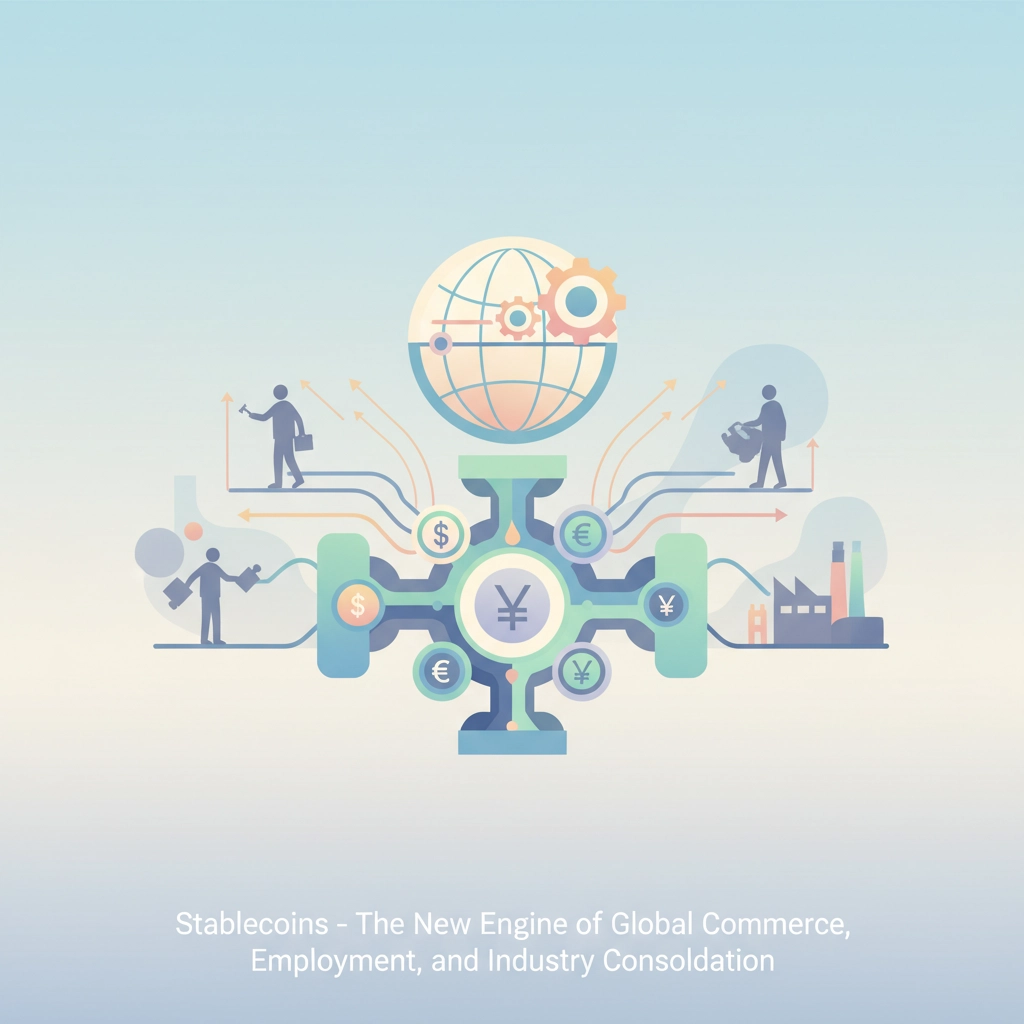
Picture this: in 2024, a new financial technology processed more transactions than Visa and Mastercard combined. We're talking about a staggering $27.6 trillion in volume: and most people still don't fully grasp what's happening. Welcome to the stablecoin revolution, where digital dollars are quietly reshaping how the world does business, creating jobs, and forcing trillion-dollar companies to completely rethink their strategies.
If you think crypto is just about speculation and meme coins, think again. Stablecoins: digital tokens pegged to real-world assets like the US dollar: have become the backbone of a financial transformation that's happening right under our noses. And here at DevFlexCo, we're fascinated by how this tech is creating opportunities for businesses, freelancers, and entire economies worldwide. Platforms like SwiftFi are part of that shift, bringing clearer payment rails and automation to global teams.
The Commerce Revolution Nobody Saw Coming
Let's start with the numbers that'll blow your mind. Stablecoins now represent about 1% of all US dollars in circulation, with a market cap that blasted past $300 billion in 2025 thanks to regulatory clarity from initiatives like the US GENIUS Act. But here's where it gets really interesting: these aren't just numbers on a screen. They're powering real businesses solving real problems.
Take SpaceX, for example. When they're selling Starlink services in countries like Argentina or Nigeria: places where local currencies are about as stable as a house of cards in a hurricane: they use stablecoins to move money back to the US. No waiting days for international wires, no losing chunks to currency fluctuations, no dealing with banks that might not even exist in some regions.

The magic happens in emerging markets where traditional banking infrastructure is spotty at best. In Africa, freelancers are ditching expensive bank transfers and using USDT to receive payments instantly. In Latin America, platforms like Bitso and Circle are processing billions in remittances monthly, cutting costs and settlement times from days to minutes.
But it's not just about replacing old systems: stablecoins are enabling entirely new business models. Supply chains can now make payments 24/7 across borders without worrying about bank holidays or time zones. Enterprise adoption is exploding, with 86% of major companies now having the infrastructure ready to handle stablecoin payments, and 60% of Fortune 500 companies actively building on-chain solutions.
The IMF has noted something crucial here: stablecoins are actually reinforcing the US dollar's dominance as the global reserve currency. Instead of challenging American financial supremacy, they're extending it into every smartphone and internet connection worldwide.
Creating Jobs and Financial Freedom
Here's where things get really exciting from an economic perspective. Stablecoins aren't just changing how we move money: they're creating entire new job categories and opportunities for people who were previously shut out of the global economy.
Think about a talented graphic designer in rural Kenya who can now receive instant USD payments for work done for a client in New York. No need for expensive wire transfers that eat up 10-15% of their payment. No waiting a week for funds to clear through multiple correspondent banks. Just instant, direct payment in a currency that holds its value.
The numbers tell the story: DeFi platforms integrated with stablecoins are now managing over $11 billion in loans, offering credit at rates that are 100 basis points cheaper than traditional banks. This isn't just disrupting banking: it's democratizing access to capital in ways we've never seen before.

For businesses, the impact on payroll is revolutionary. Companies with remote teams can now pay workers across dozens of countries instantly, without dealing with different banking systems, currency conversions, or the nightmare of international payroll compliance. One transaction, settled in minutes, with transparent fees that are a fraction of traditional methods.
The employment ripple effects are massive. We're seeing explosive growth in:
- Blockchain developers and smart contract specialists
- Crypto-native customer support teams
- Regulatory compliance experts for digital assets
- Treasury managers who understand tokenized cash
- Platform specialists who can bridge traditional finance with DeFi
Meanwhile, $2.6 trillion in real-world transactions like payrolls and remittances are driving economic growth in regions that traditional banking has left behind.
The Great Financial Consolidation
Now here's where things get spicy. The biggest names in finance are scrambling to buy their way into the stablecoin game, and the acquisition spree is absolutely wild.
Coinbase and Mastercard are eyeing a $2 billion acquisition of BVNK, a fintech that processes $20 billion annually. Stripe dropped $1.1 billion to acquire Bridge, while Ripple snatched up Rail for $200 million. These aren't small plays: these are "we need to own this infrastructure or we're dead" moves.
The StablecoinX Assets merger with TLGY Acquisition Corp raised $890 million just to acquire 3 billion ENA tokens and get listed on Nasdaq under the ticker "USDE." When traditional companies are paying nearly a billion dollars for digital tokens, you know the game has changed.

What's driving this frenzy? Simple: traditional payment companies are watching their business models get disrupted in real-time. When stablecoins can process transactions faster and cheaper than Visa or Mastercard, those companies have two choices: adapt or become irrelevant.
The regulatory clarity from the US GENIUS Act in July 2025 has been a game-changer, propelling the stablecoin market past $300 billion and unleashing a wave of M&A activity. Companies like Coinbase, Kraken, and Ripple are racing to lock up critical infrastructure before their competitors do.
The Tech Stack That Changes Everything
From a technology perspective, what's happening here is fascinating. Stablecoins aren't just digital money: they're programmable money running on global, 24/7 infrastructure that never sleeps.
For AI companies, the impact is huge. Programmable payments paired with clean on-chain data open the door to automated reconciliation, intelligent treasury routing, fraud detection, and predictive cash-flow insights built directly into product workflows.
Smart contracts can automatically split payments, handle escrow arrangements, and execute complex business logic without human intervention. Imagine payroll systems that automatically distribute salaries, bonuses, and benefits across multiple currencies and jurisdictions with a single transaction.
The on-chain forex markets are particularly interesting. With 86% of enterprises now infrastructure-ready, we're seeing the emergence of a parallel financial system that operates alongside: and often more efficiently than: traditional banking.
For developers and tech companies like DevFlexCo, this opens up incredible opportunities to build solutions that were impossible with traditional payment rails. APIs that can move money instantly across borders, smart contracts that automatically handle multi-party transactions, and user experiences that make international commerce as simple as sending an email.
Looking Ahead: A Stable Future?
Stablecoins aren't just the newest kid on the block: they're the foundation of a more inclusive, efficient global economy. By supercharging commerce and employment while attracting massive investments through consolidation, they're set to move trillions on-chain in the coming decade.
Whether you're a business owner, freelancer, or investor, keeping an eye on this space could pay off big time. As regulations solidify and adoption accelerates, stablecoins might just become the default for how the world does money.
The question isn't whether this transformation will happen: it's whether you'll be ready for it. At DevFlexCo, we're already exploring how to integrate stablecoin payments into the solutions we build for clients. The infrastructure is here, the regulations are coming, and the opportunities are massive.
What do you think: ready to go stable? The future of global commerce is being written in code right now, and it's running on rails that never close, never sleep, and never ask for your papers at the border. That's the kind of innovation that gets us excited about what's possible when technology meets real human needs.
- Email is a crucial channel in any marketing.
- Curious what to say? How to say it?
- Whether you’re kicking off a new campaign.
- Habitasse per feugiat aliquam luctus accumsan curae

John Pastre
Email is a crucial channel in any marketing mix, and never has this been truer than for today’s entrepreneur. Curious what to say.